These four installment chapters are drawn from an exhibition at the Museum of Modern Art on Félix Fénéon, 1861-1944. "One of the most influential figures in the history of modern art is also one of the least know: Félix Fénéon, a Fresh art critic, editor, publisher, dealer, collector, and anarchist who was active in Paris during the late nineteenth and early twentieth centuries. Fénéon tirelessly advocated for avant-garde art, literature, and politics, working behind the scenes for more than five decades.
He began his career as a critic, contributing to dozens of progressive journals in the a880's and 1890's. In 1886, he coined the term New-Impressionism to describe the work of Seurat and Signac, the first of many modern artists he would ardently champion.In the early twentieth century he became a dealer and engaged with a new generation of artists, signing Henri Matisse to his first gallery contract in 1909, and giving the Italian Futurists their breakthrough exhibition in 1912. As a patron, Fénéon amasses an extraordinary collection of paintings by Seurat, Signac, Matisse, PierreBonnard, Modigliani, and may others. H was also one of the first European collectors of art from Africa, Oceania and the Americas and he endeavored to bring recognition to such works. His anarchism- for which he was arrested, in connection with bombing in 1894- shaped his belief that art could play a fundamental role in the formation of more just and harmonious world."


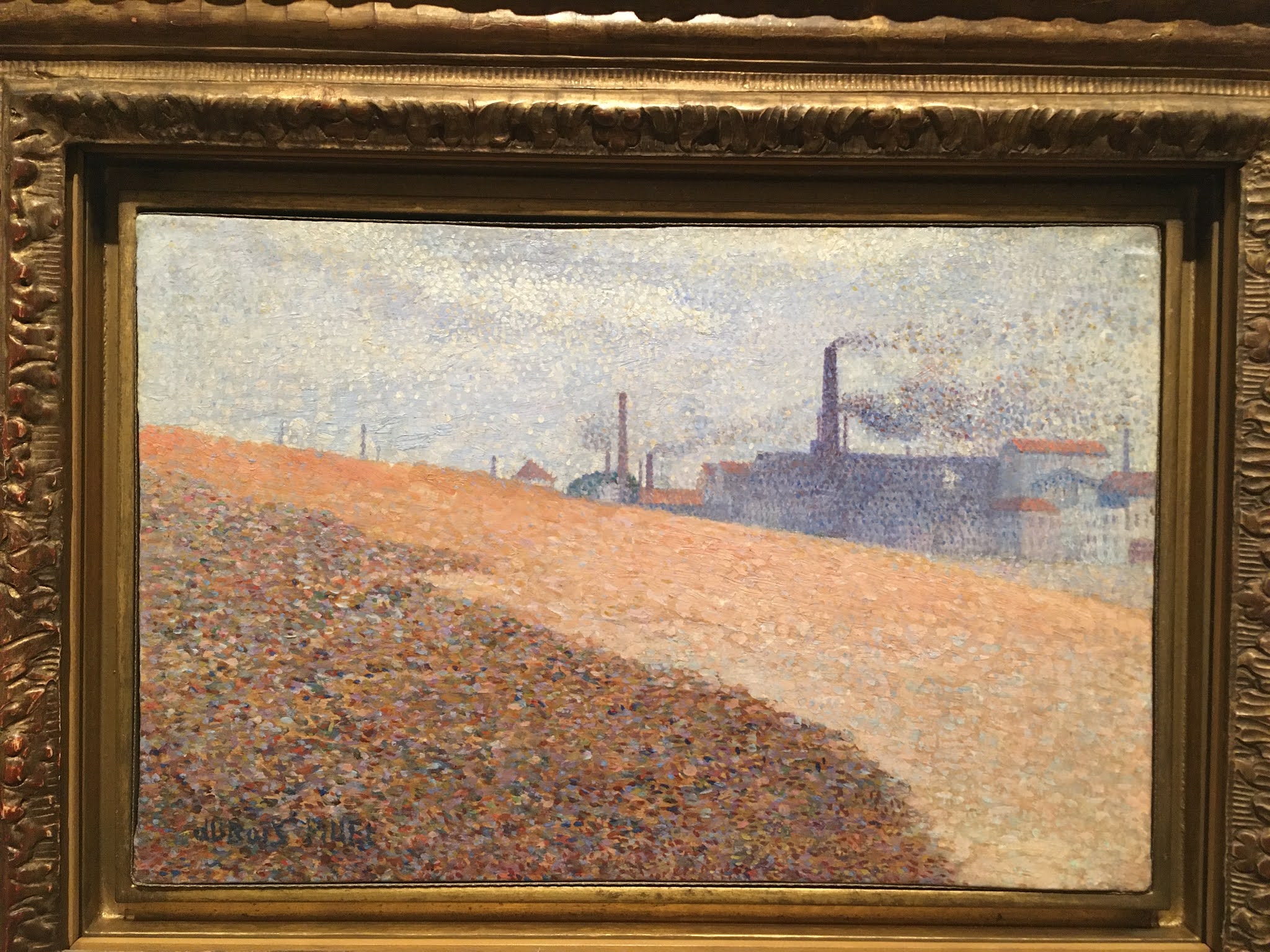
Félix Fénéon coined the term Neo-Impressionism in 1886 to describe a style founded by Georges Seurat and was a champion of many of the artists, especially Seurat and Signac. It was involved with political theories of anarchism and scientific studies of light and color.
Henri, Edmond Cross, French, The Golden Isles, 1891-92.


George-Pierre Seurat, French, Seated Woman with a Parasol, 1884-85.

"The most sensational of the myriad exhibitions that Fénéon organized was 'The Italian Futurist Painters' in February 1912. Launched three years earlier, Futurist paintings combined the color principles of the New-Impressionists and the fractured forms of the rivaling Cubists with their own distinctive subject matter: revolutionary politics and the speed and dynamism of the modern experience. While the exhibition received mostly negative reviews, partly in response to the artists' bombastic rhetoric, it drew huge crowds and catapulted the Futurists into the European avant-garde."
Luigi Russell, Italian, The Revolt. c. 1911.


Giacomo Balla, Italian, Street Light, c. 1910-11.
Fénéon also was one of the first Europeans to champion art from Africa, Oceania and the Americas.
Fénéon worked in a prestigious gallery and collected art himself, promoting artists that were not well known and struggling at the time, but who became famous and successful later (Matisse).
''I aspire only to silence, ' Fénéon once said. He realized this aim toward the end of his life in the ultimate act of self-erasure; rather than bequeathing his art collection to a French museum, he decided to disperse it through a series of auctions. The first took place in December 1941, when he needed funds for cancer-related bills. Following his death in 1944, and that of his wife Fanny in 1946, more than eight hundred remaining works were sold in four record-setting sales: three for his collection of art from Europe, and one for his collection of objects and sculptures from Africa, Oceania and the Americas."
"Anarchism flourished during the late nineteenth and early twentieth centuries in France, a period often referred to as the Belle Époque. Though celebrated for its extraordinary cultural achievements, the era saw horrendous economic devastation for the working class, instilling in many a profound distrust of state institutions. Anarchists like Fénéon and his artist friend Paul Signac believed that the dissolution of the government, capitalism, and the bourgeoisie would allow social harmony, economic fairness, and artistic freedom to prevail."
Paul Signac, French, Sunday. c. 1888-90. "Signac subtly criticizes bourgeois ideals by painting a bored couple in their ornate Parisian living room on a gloomy Sunday afternoon. Despite their middle-class comfort, husband and wife are turned away from each other, alone with their separate thoughts. Signac's use of taut geometries reinforces the rigidity of the mood."